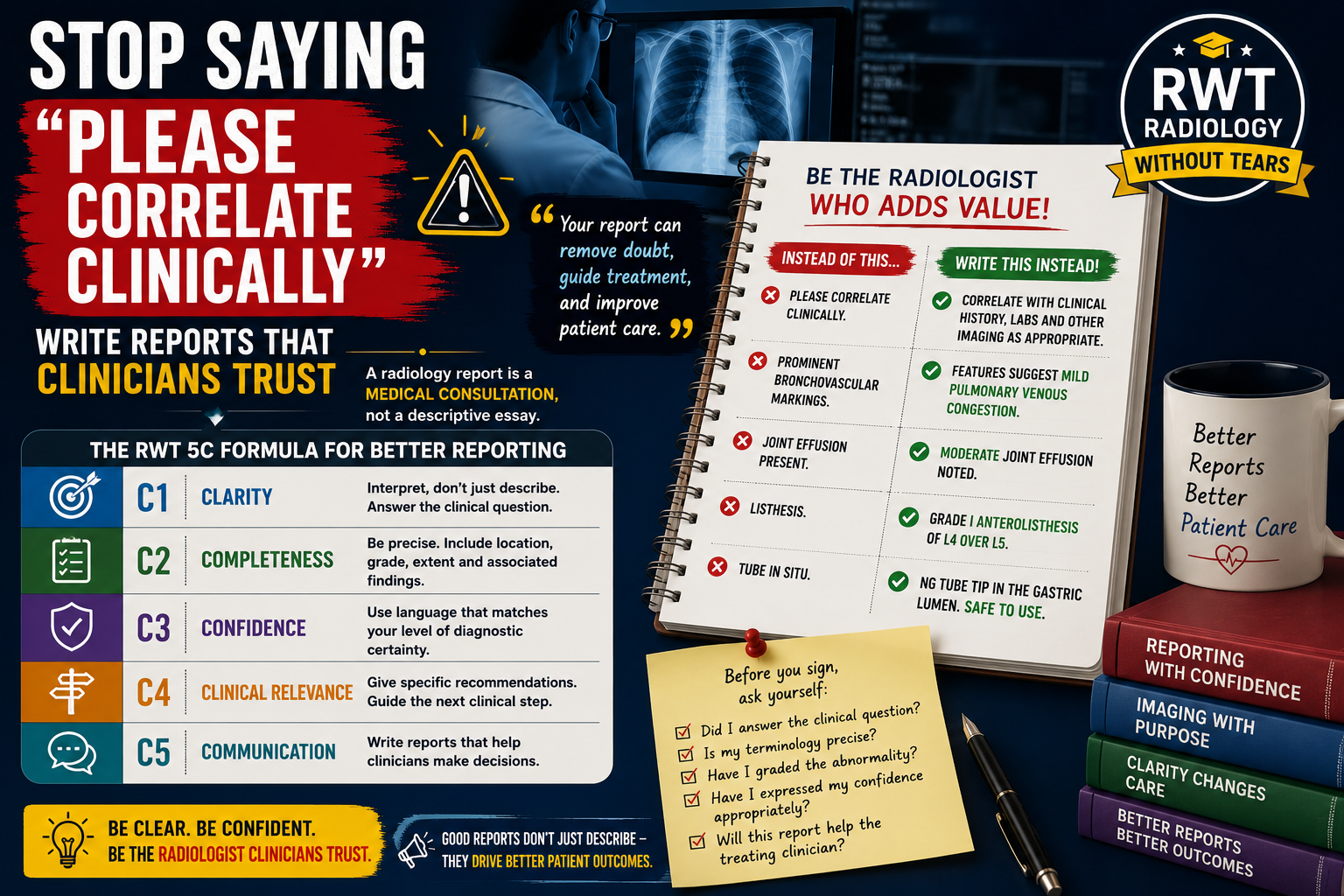
Stop Saying " Kindly Correlate clinically "
-Dr Niharika Prasad
The RWT 5C Formula for Writing Better Radiology Reports
"A radiology report is not just a description of an image. It's a medical consultation."
Have you ever signed a report and wondered...
"Did I actually help the clinician?"
As radiologists, we spend years learning how to identify abnormalities.
But very little time is spent learning how to communicate our opinion effectively.
A great radiology report doesn't simply describe findings—it answers the clinical question, reflects your level of confidence, and helps the treating clinician decide what to do next.
Here is the RWT 5C Formula that can instantly improve your reporting.
C1 – Clarity: Don't Just Describe. Interpret.
One of the common mistakes in reporting is stopping at image description.
For example...
Prominent bronchovascular markings.
This is only an observation.
Instead, ask yourself:
- Is this an age-related normal finding?
- Is it pulmonary venous congestion?
- Is there interstitial pulmonary edema?
- Is it related to chronic airway disease?
Whenever the imaging findings permit, provide your most likely interpretation rather than leaving the clinician to interpret your description.
Remember: A radiologist adds value through interpretation—not merely description.
C2 – Completeness: Be Precise
Specific reports build confidence.
Instead of writing...
Mild listhesis.
Write...
- Grade I anterolisthesis of L4 over L5.
- Then mention relevant associated findings whenever appropriate:
- Pars defect (spondylolysis)
- Central canal stenosis
- Foraminal narrowing
- Nerve root compression
Similarly...
Instead of: Joint effusion present.
Write: Mild / Moderate / Large joint effusion.
Small details often influence clinical management.
C3 – Confidence: Choose Your Words Carefully
Every reporting phrase reflects your level of diagnostic confidence.
Use them deliberately.
| Reporting Phrase | What It Conveys |
|---|---|
| Consistent with | Very high confidence |
| Suggestive of | High confidence |
| Likely represents | Moderate to high confidence |
| Possible | Moderate confidence |
| Cannot be excluded | Low confidence |
Avoid defensive reporting.
If the imaging findings strongly support a diagnosis, say it confidently.
If genuine uncertainty exists, explain why and recommend the most appropriate next step.
C4 – Clinical Relevance: Don't Stop at "Clinical Correlation Advised"
One of the most overused phrases in radiology is:
Clinical correlation advised.
The problem?
It rarely tells the clinician what should be correlated.
Instead, be specific.
For example:
- Correlate with inflammatory markers if infection is suspected.
- Follow-up chest radiograph after completion of antimicrobial therapy to document resolution and exclude an underlying obstructing lesion.
- HRCT may be considered if diffuse interstitial lung disease is clinically suspected.
Specific recommendations are far more useful than generic statements.
C5 – Communication: Think Like the Treating Clinician
Before signing every report, pause for a moment and ask yourself:
- Have I answered the clinical question?
- Have I interpreted the findings instead of merely describing them?
- Is my terminology precise?
- Have I expressed my level of confidence appropriately?
- Will this report genuinely help the treating clinician manage the patient?
If the answer is Yes, you've done much more than write a report.
You've provided a radiology consultation.
The Bottom Line
The best radiology reports are not necessarily the longest.
They are the clearest.
They don't hide behind vague terminology.
They don't overuse defensive phrases.
And they don't leave the clinician wondering what to do next.
A great radiology report should answer three simple questions:
- What is abnormal?
- What is the most likely diagnosis?
- What should happen next?
If your report consistently answers these questions, you're not just becoming a better reporter...
You're becoming a better radiologist.
Acknowledgement
This article is inspired by the excellent teaching points shared by Dr. Niharika Prasad (MD, FRCR) on clarity, confidence, and standardization in radiology reporting, adapted into the RWT teaching style for educational purposes.
Stop Saying "Clinical Correlation Advised": The RWT 5C Formula for Better Radiology Reports
The RWT 5C Formula: Write Reports That Clinicians Trust
- Clarity
- Completeness
- Confidence
- Clinical Relevance
- Communication