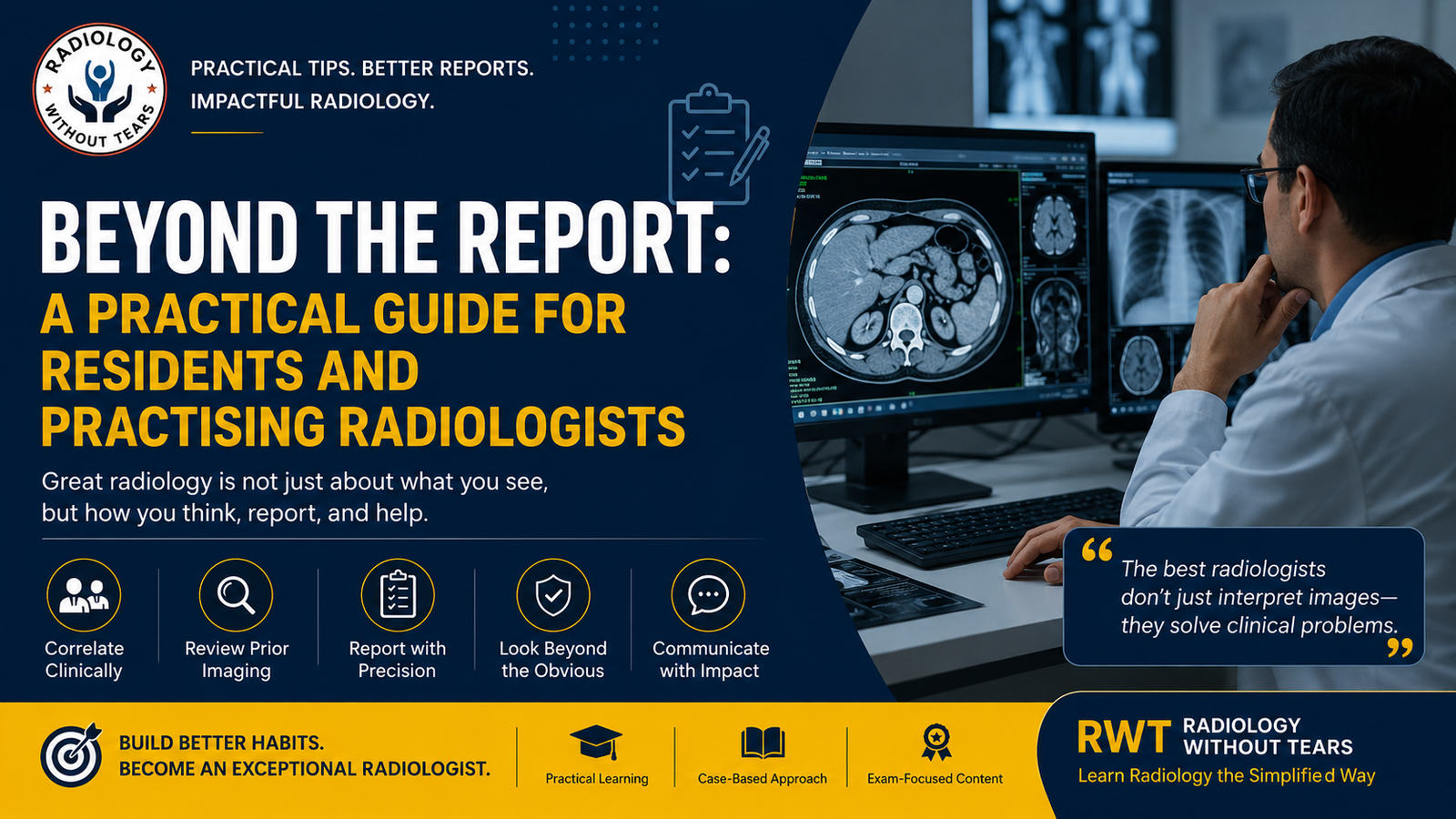
Beyond the Report: A Practical Guide for Residents and Practicing Radiologists
Radiology is often considered a behind-the-scenes specialty. However, whether you are a resident or an experienced radiologist, your role extends far beyond identifying imaging findings. Every report influences patient management, clinical decision-making, and ultimately patient outcomes.
The best radiologists do more than describe abnormalities. They integrate imaging findings with clinical history, physical examination, and sound clinical judgment to provide meaningful guidance for patient care.
This article shares practical habits that can transform a good radiologist into an exceptional clinician.
1. Become a Clinical Detective
Great radiologists never interpret images in isolation. Every scan has a clinical story.
Review Previous Imaging
Always compare with previous studies whenever available.
- Assess interval changes in lesion size.
- Compare imaging characteristics over time.
- Never assume a lesion is benign without reviewing prior examinations.
- Even if comparison has not been specifically requested, make it a routine habit.
Often, interval change is more valuable than the appearance of the lesion itself.
Correlate with Clinical Examination
Ultrasound is one of the few imaging modalities where the radiologist can directly interact with the patient.
For patients with abdominal pain:
- Look for probe tenderness.
- Ask the patient to localize the pain.
- Use a high-frequency linear probe to examine the right iliac fossa whenever appropriate.
- Combine imaging findings with clinical examination before reaching a conclusion.
Clinical correlation often prevents missed diagnoses.
2. Look Beyond the Obvious
Do Not Stop at Fatty Liver
Fatty liver should never become the final diagnosis without careful evaluation.
Always assess:
- Liver surface nodularity.
- Liver echotexture.
- Portal vein diameter.
- Portal vein thrombosis.
- Splenic size.
- Signs of portal hypertension.
Missing chronic liver disease because attention was focused only on echogenicity is a common reporting error.
Improve Your Obstetric Ultrasound Practice
When evaluating placenta previa or a low-lying placenta:
- Fill the bladder if visualization is inadequate.
- Perform a transvaginal ultrasound whenever indicated.
- Recommend the most appropriate imaging technique rather than limiting yourself to the requested examination.
Similarly, in early pregnancy:
- Perform transvaginal ultrasound when necessary.
- Confirm gestational age accurately.
- Evaluate for early pregnancy complications.
Your initiative may significantly improve patient care.
Look Beyond Software Measurements
Do not depend entirely on machine-generated fetal centiles.
If one fetal parameter lags behind the others:
- Mention it in the report.
- Consider the possibility of fetal growth restriction.
- Perform Doppler evaluation whenever clinically appropriate, even if it was not specifically requested.
Small additional efforts can have a major clinical impact.
3. Be Precise While Reporting Devices
Never simply write "in situ."
Always evaluate the exact position of:
- Endotracheal tubes.
- VP shunts.
- Intercostal drainage tubes.
- Central venous catheters.
- Feeding tubes.
If a device is malpositioned:
- State it clearly.
- Describe the complication.
- Explain its possible clinical significance.
Your report may directly influence patient management.
4. Develop the Marker Habit
Whenever CT or MRI is performed for pain, swelling, trauma, or a palpable lump, ensure that the exact site is identified.
If a skin marker has not been placed:
- Go back to the patient.
- Identify the exact location.
- Repeat localization if necessary.
This simple habit converts an average study into a highly accurate examination.
Practical Habits of Excellent Radiologists
- Review previous imaging before reporting.
- Correlate imaging with clinical history.
- Examine the patient whenever appropriate.
- Follow a systematic search pattern.
- Look beyond the obvious diagnosis.
- Report devices accurately.
- Communicate findings clearly.
- Suggest additional imaging when necessary.
- Take ownership of patient care.
Final Thoughts
Radiology is an extension of clinical medicine. A radiologist should not function merely as a reporter of images but as a clinical consultant who helps solve patient problems.
By integrating imaging findings with history, examination, and clinical judgment, you become an indispensable member of the healthcare team.
"Common sense is the knack of seeing things as they are, and doing things as they ought to be done." - C. E. Stowe
About Radiology Without Tears (RWT)
Radiology Without Tears (RWT) provides practical, exam-oriented radiology education through books, spotters, case discussions, long cases, OSCE preparation, DICOM teaching cases, quizzes, and interactive learning resources for MD, DNB, DMRD, FRCR, and NEET-SS aspirants.
At RWT, we are always there to help you succeed in your exams. ????