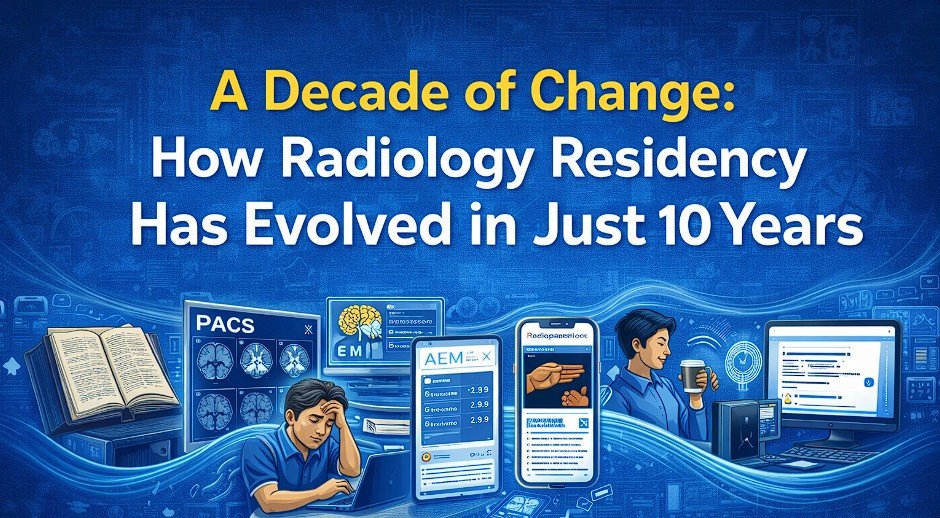
Earlier, learning radiology meant spending long hours with heavy textbooks, flipping through printed films, and waiting for the right moment to ask a senior or faculty member a question. Today, the same resident might solve that doubt in minutes, cross-check it with multiple sources, and even discuss it with peers across the country.
Let’s break down what has actually changed.
1. Learning Has Become Instant and Continuous
Access to information used to be the bottleneck. Now it’s the opposite problem.
Residents today carry an entire library in their pocket. Whether it’s revising differentials, checking imaging signs, or reading the latest guidelines, everything is available immediately. Platforms like Radiology Without Tears, online journals, and teaching apps have made learning:
-
Faster
-
More interactive
-
Constant, rather than limited to “study hours”
The key shift is this: learning is no longer location-dependent. It happens between cases, during reporting, even over coffee.
2. PACS Is Now a Learning Engine, Not Just Storage
PACS used to be a passive archive. Now it’s an active teaching tool.
Modern systems allow:
-
Multiplanar reconstructions
-
Cine review
-
Easy comparison with prior studies
-
Quick case retrieval
Residents can build their own teaching files, revisit interesting cases, and correlate findings much more effectively. This has tightened the feedback loop between seeing a case and actually understanding it.
3. Clinical Context Is Always Available
Earlier, getting clinical details often meant chasing files or relying on incomplete histories.
With integrated electronic medical records:
-
Lab values
-
Prior imaging
-
Clinical notes
are available instantly.
This has changed reporting from being image-focused to being clinically integrated, which is how radiology is meant to be practiced.
4. AI Has Entered the Workflow Quietly
Artificial intelligence is not replacing residents. It’s reducing friction.
Common tools now assist with:
-
Structured scoring systems
-
Automated measurements
-
Risk calculators
-
Workflow prioritization
This means residents spend less time on repetitive tasks and more time on interpretation and decision-making. The cognitive part of radiology is getting more emphasis.
5. Reporting Has Become Faster and More Structured
Typing long reports used to be time-consuming and mentally draining.
With speech-to-text systems:
-
Reports are generated in real time
-
Structured formats are easier to maintain
-
Turnaround time improves
This also encourages clearer thinking. When you dictate, your report reflects how you process the case.
6. Learning Is No Longer Limited by Geography
One of the biggest changes is access to global teaching.
Residents today can:
-
Attend international webinars
-
Watch recorded lecture series
-
Participate in online case discussions
This has flattened the learning curve across institutions. Exposure is no longer limited to where you train.
So What Has Actually Changed?
Almost everything on the surface.
-
The tools are faster
-
The information is abundant
-
The workflow is streamlined
But the core remains the same.
Radiology still depends on:
-
Careful observation
-
Pattern recognition
-
Clinical reasoning
-
Curiosity
Technology can accelerate learning, but it cannot replace thinking.
The Real Takeaway for Residents
You are training in a system that is more powerful than ever before. But that comes with a responsibility.
Easy access to information can create an illusion of knowledge. The real skill lies in:
-
Knowing what matters
-
Interpreting correctly
-
Applying it in the right clinical context
Use the tools. Don’t depend on them.
Radiology has not just evolved. It has expanded.
The pace is faster, the reach is wider, and the possibilities are larger. But at its core, it is still the same discipline that rewards those who look carefully, think clearly, and keep learning.
The future is not coming. You are already in it.