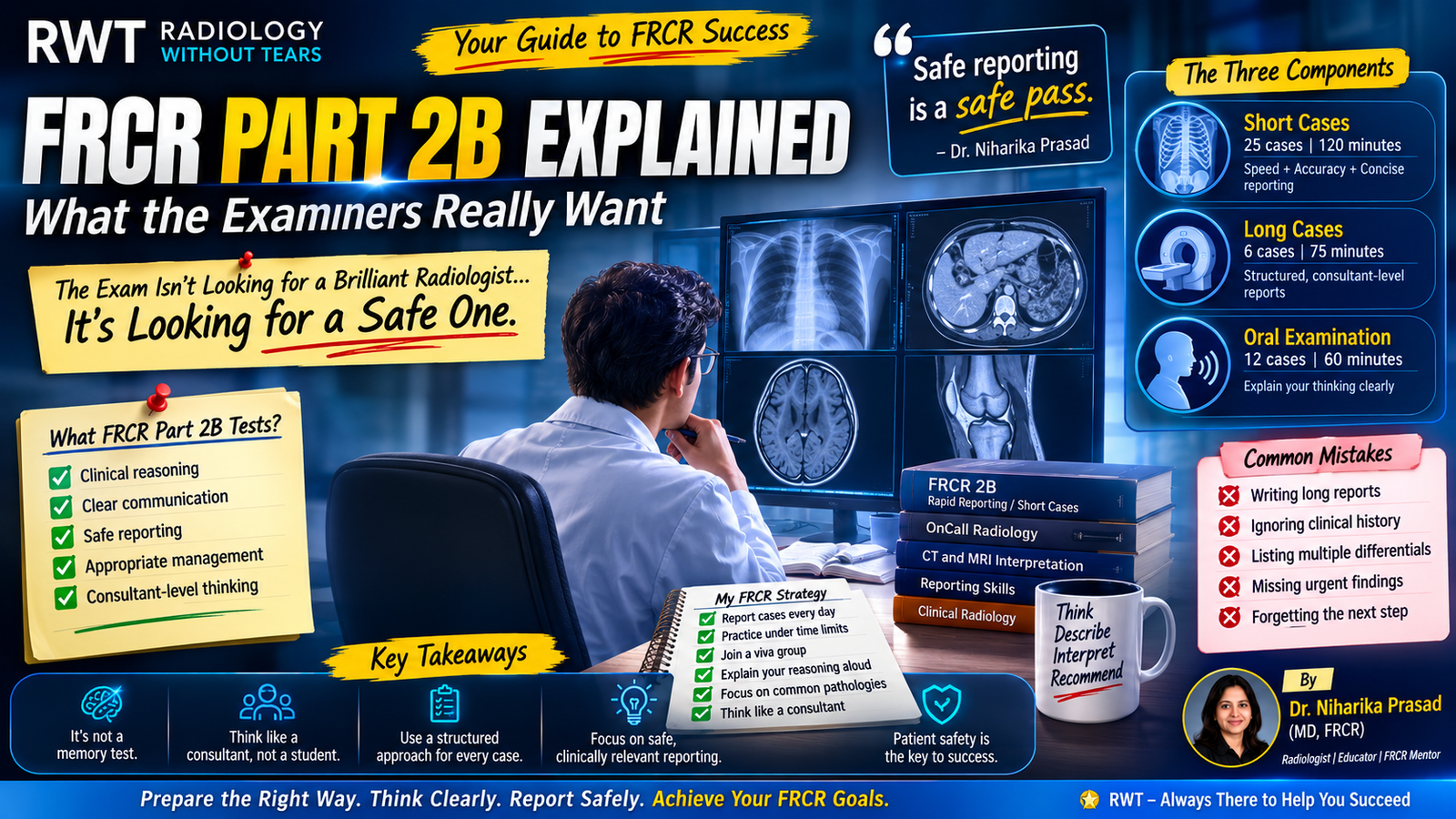
FRCR Part 2B Explained: What the Examiners Really Want
The Exam Isn't Looking for a Brilliant Radiologist. It's Looking for a Safe One.
By Dr. Niharika Prasad (MD, FRCR)
"I've studied for months... but I still don't feel ready for FRCR Part 2B."
If that's how you're feeling, you're not alone.
For many radiologists, FRCR Part 2B is the most challenging stage of the entire FRCR journey. Not because the syllabus is impossible, but because many candidates aren't quite sure what the examiners are actually looking for.
Do they expect rare diagnoses?
Perfect reports?
A photographic memory?
Fortunately, the answer is No.
The FRCR Part 2B examination is not designed to find the smartest radiologist in the room.
It's designed to identify a radiologist who can recognize important findings, think logically, communicate clearly, and report safely.
Once you understand that, your entire approach to preparation changes.
The Biggest Myth About FRCR Part 2B
Many candidates spend months memorizing recalls and previous questions.
While recalls are undoubtedly useful for practice, they are not enough on their own.
Unlike many traditional postgraduate examinations, FRCR rewards clinical reasoning more than memorization.
The examiners want to know:
- Can you identify the important imaging findings?
- Can you communicate your interpretation clearly?
- Can you suggest appropriate management?
- Above all... can you report safely?
FRCR Pearl
Safe reporting is a safe pass.
If you remember just one sentence from this article, let it be this.
How Is FRCR Part 2B Different from Indian Postgraduate Exams?
If you've completed your MD or DNB in India, you'll immediately notice an important difference.
In many postgraduate practical examinations, reaching the correct diagnosis is often the primary goal.
In FRCR Part 2B, the diagnosis is only one part of the assessment.
The examiner also wants to know:
-
Can you structure your report logically?
-
Can you recognize urgent findings?
-
Can you recommend the appropriate next step?
-
Can you communicate safely as a consultant radiologist?
Remember...
You're no longer being assessed as a postgraduate student.
You're being assessed as a future consultant radiologist.
Understanding the Three Components
Although the examination has three different sections, they all assess the same fundamental skill.
Can you think like a safe reporting radiologist?
Short Cases
Short cases assess your ability to interpret plain radiographs accurately within a limited time.
The emphasis is not on writing lengthy reports.
Instead, focus on:
-
Important imaging findings
-
Most likely diagnosis
-
Appropriate next investigation or management when required
Think: Describe → Diagnose → Recommend.
Long Cases
Long cases assess whether you can produce a consultant-level report on cross-sectional imaging.
A simple reporting structure works every time:
-
Observations
-
Interpretation
-
Principal diagnosis
-
Focused differential diagnosis (only if relevant)
-
Appropriate management or next step
Remember...
The examiner wants a report that a clinician can confidently use for patient management.
Oral Examination
Many candidates fear the viva more than any other component.
In reality...
The viva is not a memory test.
It's an assessment of how you think.
The examiner wants to understand your reasoning.
Whenever you're shown a case:
-
Describe the findings.
-
Interpret them.
-
Give your most likely diagnosis.
-
Mention a focused differential if appropriate.
-
Suggest the next investigation or management.
And if you don't immediately know the diagnosis...
Keep describing what you see.
Silence never earns marks.
The Biggest Mistakes Candidates Make
Interestingly, most candidates don't lose marks because they lack knowledge.
They lose marks because of avoidable reporting mistakes.
Some of the common ones include:
- Writing unnecessarily long reports.
- Ignoring the clinical history.
- Listing multiple unlikely differential diagnoses.
- Missing obvious emergency findings.
- Forgetting to recommend the next clinical step.
Notice something?
Most of these are communication problems, not knowledge problems.
Think Like a Consultant, Not an Exam Candidate
One simple habit can dramatically improve your performance.
Whenever you see a case, don't immediately ask:
"What's the diagnosis?"
Instead ask yourself:
-
What are the key abnormalities?
-
What do they represent?
-
What is the single best diagnosis?
-
Are there any reasonable differentials?
-
What should happen next?
This sequence works beautifully in every component of the examination.
And more importantly...
It's exactly how consultant radiologists think in everyday practice.
One Case... Many Lessons
One memorable case from my own preparation taught me an invaluable lesson.
An elderly patient presented with an isolated fracture of the lesser trochanter.
At first glance, it appeared to be a straightforward traumatic fracture.
But something didn't fit.
In adults—especially elderly patients—an isolated lesser trochanter fracture should immediately raise suspicion for an underlying pathological lesion.
Further imaging eventually revealed metastatic disease from a renal cell carcinoma.
The lesson?
Never stop after identifying the first abnormality.
Always ask yourself:
"Why has this abnormality occurred?"
That single question can prevent many diagnostic errors, both in the examination and in daily reporting.
How I Would Prepare for FRCR Part 2B
If I had to prepare again, my strategy would be surprisingly simple.
- Report radiographs every day.
- Practice under strict time limits.
- Join a regular viva group.
- Explain your reasoning aloud.
- Review every incorrect answer carefully.
- Revise common pathologies repeatedly.
- Never neglect plain radiographs.
Remember...
Reading more resources doesn't necessarily make you a better candidate.
Deliberate practice does.
One Final Thought
Every FRCR candidate worries about missing a diagnosis.
The truth is...
Almost everyone misses something during preparation.
What separates successful candidates isn't perfection.
It's having a systematic approach to every case.
If you consistently:
-
Observe carefully,
-
Think logically,
-
Communicate clearly,
-
And always prioritize patient safety...
You're already preparing in exactly the way FRCR Part 2B expects.
Safe reporting isn't just an examination strategy.
It's the foundation of good radiology practice.
And that's why the most important lesson of FRCR Part 2B can be summarized in one sentence:
Safe reporting is a safe pass.
Key Takeaways
- FRCR Part 2B assesses clinical reasoning—not just memory.
- Think like a consultant radiologist, not an exam candidate.
- Use a structured approach for every case.
- Communicate clearly and recommend appropriate management.
- Patient safety should guide every report.
About the Author
Dr. Niharika Prasad (MD, FRCR) is an accomplished radiologist, educator, and FRCR mentor. Through her teaching, she emphasizes structured reporting, safe clinical decision-making, and practical strategies to help radiologists succeed in the FRCR examination.