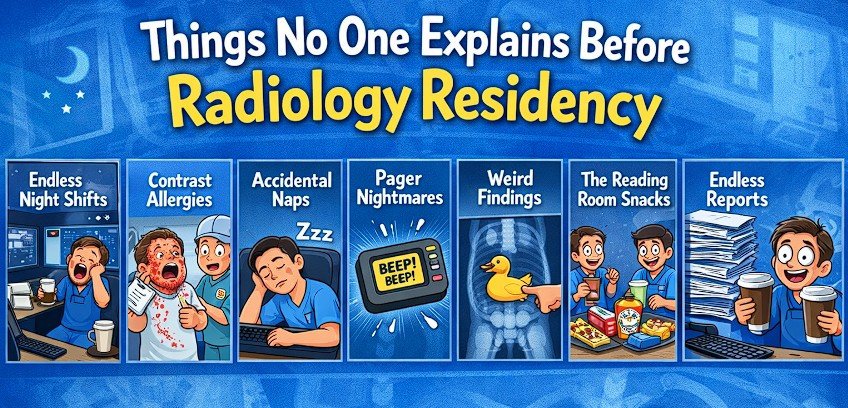
You Are Not Here by Accident
You cleared the exams. You survived the interviews. You landed the seat.
Yet medicine has a peculiar talent for making capable people feel like impostors, and radiology adds another layer by hiding most of the work behind screens and silence. So let us establish one thing early and without drama.
You belong here.
Residency will challenge your confidence many times, but self doubt is not evidence of incompetence. It is usually evidence that you care about getting things right.
This piece is not a manual. It is closer to a set of notes passed quietly across the reporting room by someone who has already tripped over the cables.
Learn the Ecosystem Before You Learn the Scanner
When you arrive, you will want to prove yourself by working harder and knowing more than everyone else. That instinct is natural. But before you chase protocols, learn the people.
Hospitals run on relationships, not algorithms.
Radiographers know the machines better than anyone. Porters control time more than any scheduling software. Nurses understand patient realities that never make it into request forms.
Be approachable. Be respectful. Be human.
One day, when something urgent needs to happen fast, the goodwill you built will quietly come back to you.
Your Words Matter as Much as Your Findings
Radiology is often misunderstood as image reading. In reality, it is translation.
You are translating anatomy and pathology into decisions other doctors must act on. If that translation is unclear, the diagnosis may as well not exist.
Different clinicians read reports differently. Physicians want probabilities. Surgeons want targets. Emergency doctors want clarity and speed.
Write as if you are answering a question, not defending an opinion.
Be careful with vague safety phrases. If you are unsure, explain why. Thoughtful uncertainty builds trust. Lazy ambiguity erodes it.
Clear communication turns images into medicine.
Stop Hunting for the Perfect Book
Early in residency, many people waste enormous energy choosing books. They buy several, skim a few, and finish none.
Here is the uncomfortable truth. Most radiology textbooks cover the same ground. The differences are in presentation, not substance.
What you need initially is not exhaustive detail. You need a framework that helps you recognize patterns.
Choose one solid core resource. Commit to it long enough for repetition to work its magic. Ignore the anxiety that whispers that someone else is reading something better.
Understanding grows from consistency, not from hoarding PDFs.
Digital Learning Is a Skill, Not a Distraction
Radiology adapted quickly to online learning because the raw material was already digital. Recorded lectures, case libraries, and virtual meetings are now standard tools.
Their biggest advantage is control.
You can pause when something does not make sense. You can replay explanations that were too fast the first time. You can revisit difficult concepts without embarrassment.
Use these resources actively. One well studied case teaches more than hours of distracted watching.
Learning improves when you slow it down.
Manage Your Energy, Not Just Your Schedule
You will meet people who wear exhaustion like a badge of honor. This is not a skill worth copying.
Good radiologists are not those who work endlessly. They are those who work deliberately.
Use templates. Build reporting shortcuts. Reduce repetitive decisions. Save mental effort for interpretation and judgment.
Plan your day in small, realistic blocks. Set a few achievable goals. Finish them.
Progress comes from momentum, not from martyrdom.
Let Cases Teach You What Books Cannot
Structured study builds foundations. Cases make those foundations stick.
You will remember a patient far longer than a paragraph in a book. Use that fact.
Keep a simple case log. Note what confused you. Note what surprised you. Follow up outcomes whenever possible.
Reflection matters. So does accepting uncertainty. Radiology is a probabilistic discipline. Absolute certainty is rare and often suspicious.
Clear thinking beats false confidence.
Think of AI as a Calculator, Not a Colleague
Artificial intelligence is already part of radiology. Ignoring it is pointless. Fearing it is unproductive.
AI is good at pattern recognition. Radiology is more than that.
It involves context, communication, procedures, judgment, responsibility, and trust. These do not reduce neatly into algorithms.
Use AI where it helps. Let it speed up searches, organize information, and assist learning. But remember that tools amplify understanding. They do not replace it.
The radiologist remains accountable.
The Report Is Where You Practice Medicine
The scan does not treat the patient. The report guides the treatment.
Early on, structured reporting protects you from omissions. As experience grows, you will naturally add nuance and narrative.
Before signing off, pause. Ask yourself simple questions.
Did I answer the clinical question?
Did I check prior studies?
Did I look where errors commonly hide?
Read older reports. Read your own reports. Learn which phrases prevent phone calls and which trigger them.
Borrow good language. That is how craft is learned.
Radiology residency can feel like wandering through a maze built of gray images and incomplete information. Everyone feels lost at first. Everyone misses things. Everyone has moments of quiet panic.
Hidden inside that confusion are moments of real discovery and genuine satisfaction.
You will grow. You will make mistakes. You will get better.
And one day, someone new will ask you how to survive radiology residency.
When that happens, tell them the truth.